


Hey there! As a supplier of encapsulation machines, I'm super stoked to break down the main components of these nifty pieces of equipment. Encapsulation machines are essential in various industries, especially in pharmaceuticals, nutraceuticals, and even some food sectors. They're the workhorses that help get powders, liquids, or semi - solids into capsules for easy consumption and dosage control. So, let's dive right in and look at what makes up an encapsulation machine.
1. Hoppers
First off, we've got the hoppers. Think of them as the storage bins for your raw materials. Different hoppers are used depending on the type of substances you're dealing with. For instance, if you're filling capsules with powders, you'll have a powder hopper. It's designed to hold a large quantity of the powder and feed it into the encapsulation process at a controlled rate.
The hopper's design is crucial. It has to prevent powder from clogging or bridging over, which can interrupt the flow. Some hoppers come with agitators or vibrating mechanisms to keep the powder moving smoothly. In the case of liquid or semi - solid filling, separate hoppers are used. They're built to handle the unique properties of these substances, like viscosity. So, hoppers are where it all starts, stocking up on the materials needed to fill those capsules.
2. Capsule Feeding System
Next up is the capsule feeding system. This is the part that takes empty capsules and positions them correctly for filling. The capsules are usually fed from a magazine or a bulk container. The system uses various mechanical and pneumatic methods to separate the capsules and orient them with the open end up so they're ready to be filled.
For example, some machines use vacuum systems to pick up individual capsules and transfer them to the filling station. Others rely on mechanical fingers or grippers. The accuracy of the capsule feeding system is vital. If a capsule isn't properly oriented or is misplaced, it can lead to incorrect filling or even machine jams. When looking for an encapsulation machine, make sure to check out the efficiency of its capsule feeding system. You can learn more about specific requirements for this system in the User Requirement Specification Capsule Filling Machine.
3. Filling Mechanisms
Now, the filling mechanisms are the heart of the encapsulation machine. There are different types, depending on what you're filling the capsules with.
Powder Filling
For powder filling, there are auger fillers and dosing discs. Auger fillers use a rotating screw to move the powder from the hopper into the capsule. The speed of the screw can be adjusted to control the amount of powder being dispensed. Dosing discs, on the other hand, have cavities of a specific volume. As the disc rotates, the cavities are filled with powder and then emptied into the capsules.
Liquid Filling
When it comes to liquid filling, pumps are the main component. Peristaltic pumps are commonly used. They work by squeezing a tube to move the liquid through it and into the capsule. Syringe pumps are another option, which are highly accurate for dosing small volumes of liquid.
Semi - solid Filling
For semi - solid substances like pastes or gels, piston fillers are often employed. The piston moves in and out of a cylinder to draw in and then expel the semi - solid material into the capsule. The flexibility of these filling mechanisms allows you to fill capsules with a wide range of products, making the encapsulation machine very versatile.
4. Capsule Closing System
Once the capsules are filled, they need to be closed properly. The capsule closing system is responsible for this. It typically consists of a set of dies or plates that gently press the two halves of the capsule together.
The closing process has to be precise. If the capsules aren't closed tightly, the contents can leak out. On the other hand, if too much pressure is applied, the capsule can break. Some machines use a series of stations to gradually close the capsules. First, the two halves are aligned, and then a light pressure is applied, followed by a final, stronger press to ensure a secure closure. An excellent example of a machine with a reliable capsule closing system is the DTJ - V Semi - auto Capsule Filling Machine.
5. Control Panel
The control panel is like the brain of the encapsulation machine. It allows operators to set and adjust various parameters such as filling volume, speed, and temperature. Modern control panels are often equipped with touch - screen interfaces, which make it easy to operate the machine.
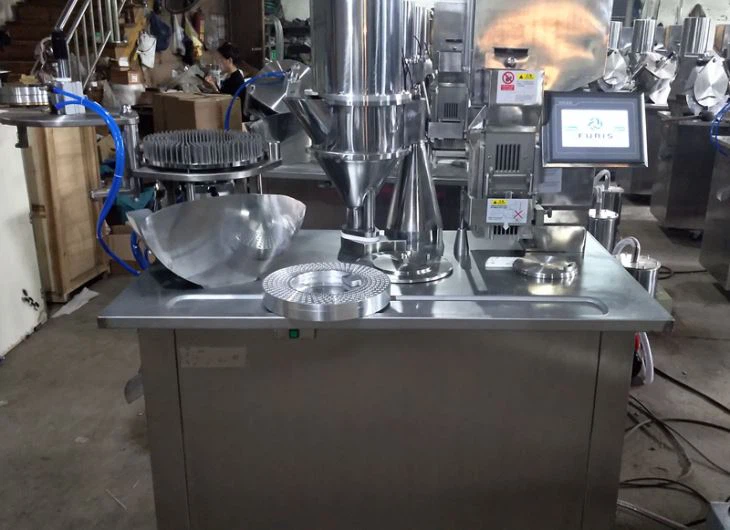

You can program the machine to run at different speeds depending on the production requirements. For example, if you're doing a small - scale batch, you might want to run it at a slower speed to ensure accuracy. But for large - scale production, you can crank up the speed. Temperature control is also important, especially when dealing with substances that are sensitive to heat. With the control panel, you can maintain the optimal temperature for filling and closing the capsules. Check out The Best Capsule In Capsule Filling Machine to see how a state - of - the - art control panel can enhance your encapsulation process.
6. Conveyor System
The conveyor system is what moves the capsules through the different stages of the encapsulation process. It starts from the capsule feeding area, passes through the filling and closing stations, and finally delivers the finished capsules to the collection point.
Conveyor belts or chains are commonly used. The speed of the conveyor system is synchronized with the filling and closing operations. If the conveyor moves too fast, the filling or closing might not be completed properly. If it moves too slow, it can slow down the entire production process. So, a well - calibrated conveyor system is essential for efficient manufacturing.
7. Rejection System
Not all capsules are going to be perfect. That's where the rejection system comes in. It's designed to detect and remove any defective capsules from the production line.
Defects can include under - filled or over - filled capsules, broken capsules, or those that aren't properly closed. Sensors are used to detect these issues. For example, weight sensors can detect if a capsule has the correct amount of filling. Optical sensors can check for visible defects like cracks. Once a defective capsule is detected, it's automatically removed from the conveyor system, ensuring that only high - quality capsules reach the end of the line.
Why Choose Our Encapsulation Machines
As a supplier, we understand that each of these components plays a crucial role in the overall performance of the encapsulation machine. That's why we pay close attention to the quality and design of every part. Our machines are built to be reliable, efficient, and easy to operate.
Whether you're a small - scale manufacturer looking for a semi - automatic machine or a large corporation in need of a high - speed, fully automatic solution, we've got you covered. Our machines are customizable to meet your specific production requirements, so you can get the most out of your investment.
If you're interested in learning more about our encapsulation machines or discussing your specific needs, don't hesitate to reach out. We're here to help you find the perfect solution for your encapsulation process.
References
- Industry - standard manuals on encapsulation machine design and operation.
- Technical documentation from leading encapsulation machine manufacturers.